


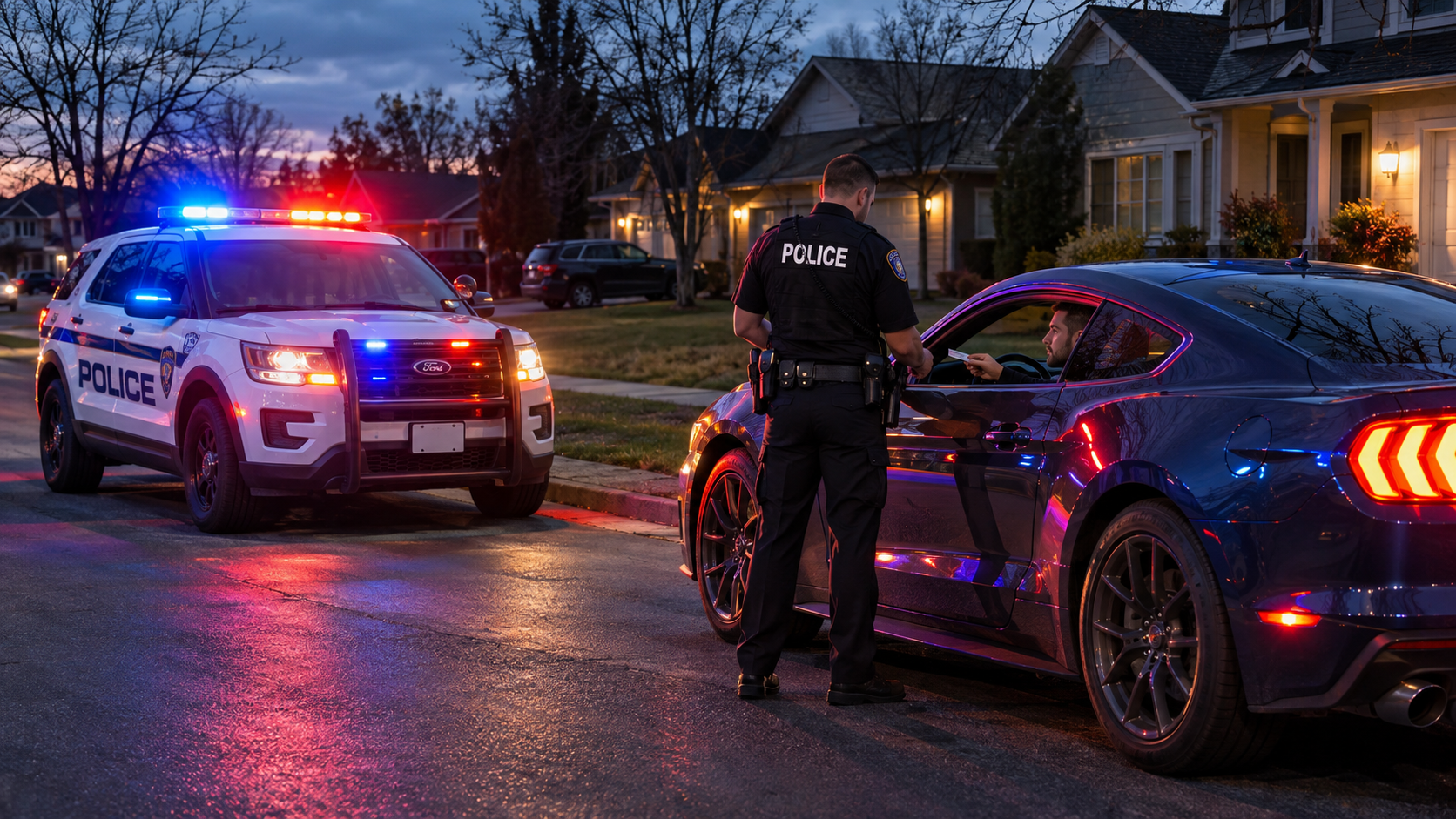
You're driving home when you notice flashing lights in your rearview mirror. Maybe you were going a little over the speed limit, drifted out of your lane, or rolled through a stop sign.
You pull over, expecting a traffic ticket or warning. But as the officer approaches your window, the questions change. Have you been drinking? Where are you coming from? Can you step out of the vehicle?
Suddenly, what started as a routine traffic stop has become something more serious.
In Pennsylvania, police can investigate a possible DUI during a lawful traffic stop if they observe circumstances that reasonably suggest impaired driving. That said, a traffic violation alone does not establish that you're driving under the influence.
If you've been cited for a traffic violation in Pittsburgh or are now facing a DUI investigation, understanding what police can legally do during a traffic stop can help you recognize why the details of your encounter matter.
What Traffic Violations Can Lead to a DUI Investigation in Pennsylvania?
Police can initiate traffic stops for many different violations of Pennsylvania's Vehicle Code. Some involve straightforward driving infractions, while others involve behavior that could also raise concerns about impairment.
Common reasons for a traffic stop include, but are not limited to:
- Speeding (75 Pa.C.S. § 3362): Driving above the posted speed limit.
- Failure to maintain your lane (75 Pa.C.S. § 3309): Failing to stay within a marked lane or changing lanes without first ensuring the movement is safe.
- Failure to obey traffic-control devices (75 Pa.C.S. § 3111): Disregarding an applicable traffic sign or other official traffic-control device.
- Running a red light or stop sign (75 Pa.C.S. §§ 3112 and 3323): Failing to obey traffic signals or required stops.
- Reckless or careless driving (75 Pa.C.S. §§ 3736 and 3714): Driving in a manner that meets Pennsylvania's legal standards for reckless or careless driving.
- Equipment violations: Operating a vehicle with a broken taillight, defective brake light, or another equipment issue that violates state requirements.
A speeding violation or broken taillight does not, by itself, justify a DUI arrest. But if an officer notices additional signs of possible impairment during the stop, the encounter can develop into a DUI investigation.
Can Police Pull You Over Just Because They Suspect DUI?
Yes. Pennsylvania law allows police to stop a vehicle when they have reasonable suspicion that the driver is operating under the influence.
But the legal standard depends on the reason for the initial stop.
Pennsylvania law generally requires police to have probable cause to stop a driver for a traffic violation that requires no further investigation, such as speeding. Still, reasonable suspicion can justify a stop when officers suspect DUI because further investigation is needed to determine whether the driver is impaired.
Reasonable suspicion must be based on specific facts rather than an unsupported assumption. For example, repeatedly weaving between lanes or braking unpredictably can raise concerns about impaired driving and provide grounds for further investigation.
The distinction matters because the legal basis for the initial stop can become an important issue if DUI charges are later filed.
What Happens if Police Suspect You're Driving Under the Influence?
A traffic stop can develop into a DUI investigation when an officer notices signs that suggest alcohol or another substance is affecting your ability to drive.
During the encounter, an officer might observe:
- The odor of alcohol coming from the vehicle or driver.
- Slurred speech or difficulty answering questions.
- Bloodshot or glassy eyes.
- Difficulty maintaining balance or coordinating movements.
- Statements indicating recent alcohol consumption.
These observations do not automatically prove DUI. For example, bloodshot eyes can have explanations unrelated to alcohol consumption. Officers must consider the circumstances and other available evidence when evaluating possible impairment.
When these observations provide reasonable suspicion of impaired driving, officers can take additional investigative steps, including requesting roadside sobriety testing.
Can Police Ask You to Take Field Sobriety Tests During a Traffic Stop?
Yes. When officers have a lawful basis to investigate suspected DUI, they can request that a driver complete field sobriety tests.
These tests are intended to help officers assess possible impairment before deciding whether an arrest is warranted.
Common field sobriety tests include, but are not limited to:
- Walk-and-turn test: Walking heel-to-toe along a line, turning, and returning as instructed.
- One-leg stand test: Standing on one leg while following the officer's directions.
- Horizontal gaze nystagmus test: Following a moving object with your eyes while the officer looks for certain involuntary eye movements.
Performance on these tests can become part of the evidence considered in a DUI investigation.
But difficulty completing a field sobriety test does not necessarily establish that someone was intoxicated.
Medical conditions, injuries, uneven pavement, poor lighting, and other circumstances can affect a person's performance.
Pennsylvania's implied-consent law does not impose an automatic license suspension simply for declining roadside physical field sobriety tests. Even so, refusing to perform them does not necessarily prevent an arrest if officers have other sufficient evidence of impairment, and the circumstances surrounding the refusal can still become relevant to the case.
What if Police Ask You to Take a Breath or Blood Test?
Pennsylvania treats roadside field sobriety tests differently from chemical testing requested in connection with a DUI arrest.
Under Pennsylvania's implied consent law, drivers are deemed to have consented to certain chemical testing when the statutory requirements are met.
If you're arrested for suspected DUI and refuse a qualifying request for chemical testing, you can face additional consequences.
These can include:
- A driver's license suspension of 12 months or, under certain circumstances, 18 months.
- Additional license restoration requirements.
- Potential use of the refusal as evidence in a DUI prosecution.
- Enhanced DUI penalties in certain cases involving refusal of breath testing or refusal of blood testing pursuant to a valid search warrant.
The rules also distinguish between breath and blood testing, particularly regarding the constitutional requirements for obtaining a sample and the consequences associated with refusal.
A preliminary breath test administered at the roadside is different from chemical testing requested after a DUI arrest. Refusing a preliminary breath test does not trigger the same automatic license-suspension provisions that apply to refusing qualifying post-arrest chemical testing.
Because refusing a qualifying chemical test can affect your driving privileges independently of the criminal DUI case, the circumstances of the testing request are important.
Can You Face Both Traffic Violations and DUI Charges?
Yes. A driver can face both traffic violations and DUI charges arising from the same incident. For example, someone stopped for speeding might receive a speeding citation and also face DUI charges if the investigation produces sufficient evidence of impaired driving.
These are separate allegations with different legal requirements. Evidence supporting a traffic citation does not automatically establish that the driver was under the influence.
The consequences depend on the violations involved, and they can extend beyond fines and points on your driving record.
Some Pennsylvania traffic offenses carry points, while others do not. For example, careless driving under 75 Pa.C.S. § 3714 generally carries three points, while violations of §§ 3111 and 3309 do not carry points under Pennsylvania's standard point schedule.
But a violation that carries no points can still matter. Depending on the circumstances, a traffic conviction can affect your insurance rates or create employment concerns, particularly if your job requires you to drive.
Commercial driver's license (CDL) holders face additional considerations. PennDOT explains that moving violations, including § 3111 offenses, are recorded on CDL holders' driving records even when they carry no points under the standard schedule. Those violations can be visible to authorized employers and insurers.
A DUI conviction carries separate consequences, including possible fines, incarceration, license-related penalties, and treatment requirements, depending on the circumstances and the driver's record.
Can You Challenge a DUI Charge That Started With a Traffic Stop?
Yes. Being arrested for DUI after a traffic stop does not mean the charge cannot be challenged.
An attorney can review whether police had a lawful basis for initiating the stop, whether the investigation was properly conducted, and whether the evidence supports the allegations.
Important questions can include:
- Did the officer have sufficient grounds to stop the vehicle?
- What observations led the officer to suspect impairment?
- Was there a lawful basis to extend the traffic stop for a DUI investigation?
- Were field sobriety tests administered and interpreted appropriately?
- Were chemical testing procedures and applicable legal requirements followed?
Dashcam recordings, body-camera footage, police reports, and chemical testing records can help clarify what occurred.
If police obtained evidence through an unlawful stop or seizure, an attorney can examine whether a motion to suppress is appropriate.
Suppressing evidence can affect the prosecution's ability to establish a DUI charge, but it does not automatically result in dismissal. The outcome depends on the circumstances and the remaining admissible evidence.
Facing Traffic Violations or DUI Charges in Pittsburgh? Contact Hadeed Law
Whether you're facing a speeding ticket, a reckless driving allegation, or DUI charges in Pennsylvania, the consequences can extend beyond fines. Your driving record, insurance costs, and even your employment could be affected, depending on the violation and your circumstances.
At Hadeed Law, Pittsburgh attorney Samir Hadeed represents individuals facing traffic violations and DUI charges in Allegheny County and throughout Western Pennsylvania. He reviews the circumstances surrounding traffic stops, examines the available evidence, and evaluates defense options based on the facts of each case.
If a traffic stop has resulted in a citation or DUI charge, contact Hadeed Law to discuss your situation and learn more about your legal options.
Disclaimer: This blog is provided for informational purposes only and should not be construed as legal advice. Reading this content does not create an attorney-client relationship. For guidance regarding your specific legal matter, please contact Hadeed Law to discuss your situation.