


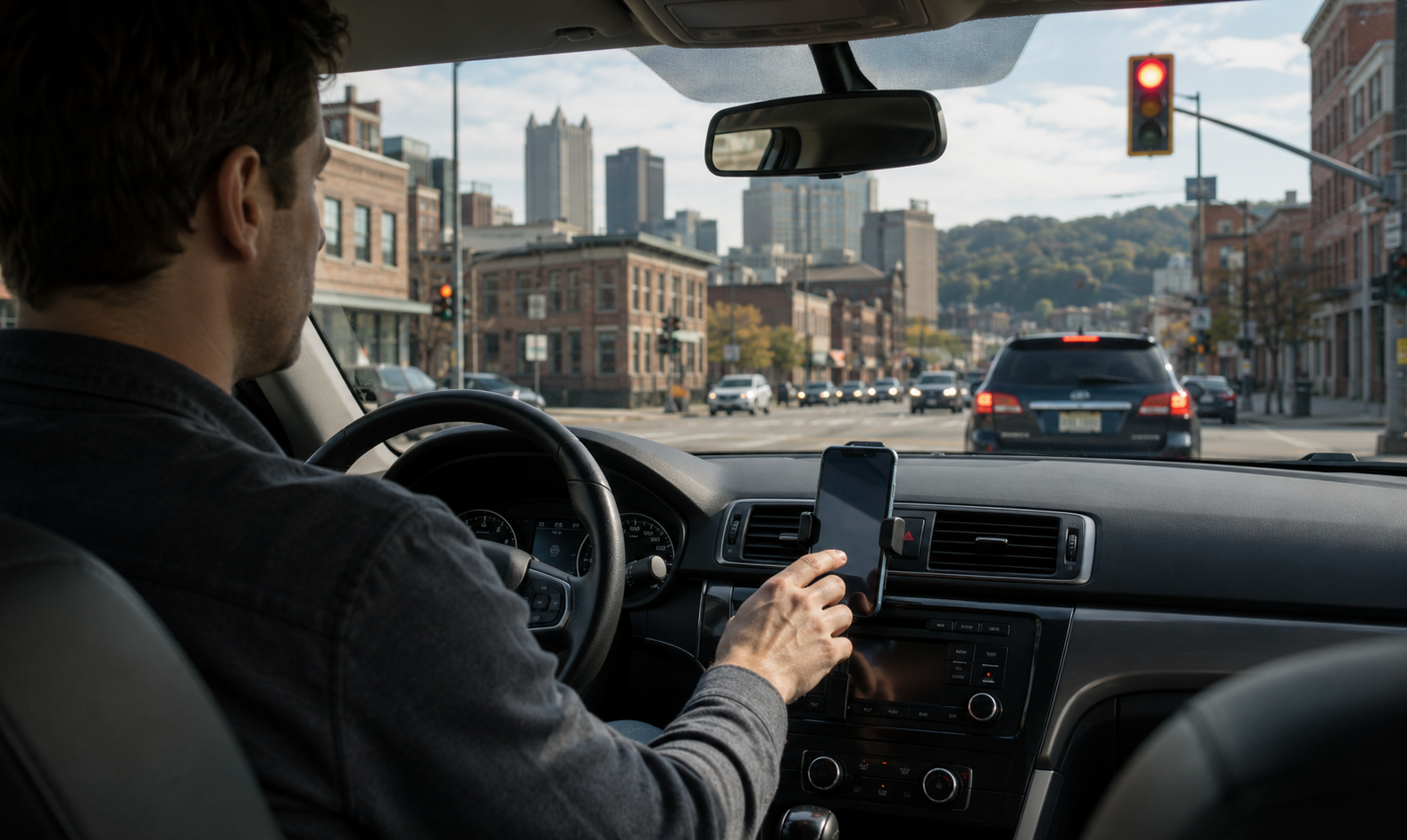
Generally, no. Under Pennsylvania’s hands-free driving law, drivers cannot hold or otherwise use an interactive mobile device in a prohibited way while temporarily stopped at a red light, sitting in traffic, or experiencing another momentary delay, subject to a narrow emergency-use exception.
Let’s say you are sitting at a red light in Pittsburgh. Traffic is backed up. Your phone buzzes. Maybe it is your boss, your spouse, your child, a navigation alert, or the person you were supposed to meet ten minutes ago.
You pick it up for one second.
Under Pennsylvania’s hands-free law, that second can result in a traffic citation.
Pennsylvania’s distracted driving law, known as Paul Miller’s Law, makes it illegal for drivers to use an interactive mobile device while driving. In practical terms, drivers generally should not have a phone in their hand, support it against their body, or reach for it in a way the law prohibits.
That rule applies not only when your car is moving down I-376, Route 28, the Parkway West, or the Pennsylvania Turnpike. It also applies when you are temporarily stopped because of traffic, a red light, a stop sign, or another momentary delay.
Now that the warning period is over, drivers convicted of violating Pennsylvania’s hands-free law face a $50 fine, plus court costs and other fees. A basic hands-free citation is not a jail or prison sentence, but it is still a traffic citation that deserves attention before you decide how to respond.
Before you pay the ticket, ignore the paperwork, or assume the stop is no big deal, it helps to understand what Paul Miller’s Law actually says, what police are looking for, and when a Pittsburgh traffic ticket lawyer can help you sort through your options.
What Does Pennsylvania’s Hands-Free Law Actually Prohibit?
Pennsylvania’s hands-free law focuses on what drivers do with the device while they are behind the wheel. Drivers cannot use an interactive mobile device while driving, except for limited emergency use. That includes holding it, supporting it with another part of the body, dialing or answering it by pressing more than a single button, or reaching for it in a way that pulls the driver out of a properly seated and belted position.
The law covers more than texting. A cell phone citation can involve holding a phone to make a call, checking notifications, scrolling, reading a message, taking a picture, watching a video, or interacting with an app.
The key point is simple: holding a phone while driving, including during a temporary stop in traffic, can result in a citation.
Hands-free use is different. Drivers can use hands-free technology to make calls, receive directions, or listen to music, as long as they are not holding, supporting, or otherwise using the device in a prohibited way. If a phone call or text message cannot wait, the safer choice is to move the vehicle to the side of or off the road and stop in a location where the vehicle can safely remain stationary before using the device.
Why a Red Light Still Counts Under Paul Miller’s Law
One of the biggest misconceptions about Pennsylvania’s hands-free law is that drivers can use their phones while stopped at a light. They should not assume that.
Pennsylvania’s hands-free law applies when a driver is temporarily stopped because of a red light, traffic congestion, a stop sign, or another momentary delay.
That means checking a text at a light in Downtown Pittsburgh, picking up your phone in Oakland traffic, scrolling while waiting on the South Side, or holding the phone at an intersection in Mt. Lebanon can still create citation risk.
To a driver, it can feel harmless. To an officer watching traffic move around you, the vehicle is still part of the roadway. The light can change. Cars can move. Pedestrians can enter the crosswalk. A driver who is looking down can miss what is happening around the vehicle.
That is the risk Paul Miller’s Law is designed to address. The light may be red, but the traffic situation around you is still active.
What Happens If You Get a Cell Phone Ticket in Pittsburgh?
A hands-free violation is a summary offense with a $50 fine, and court costs or other fees can increase the amount you actually owe. But the fine is not the only decision in front of you.
A driver who receives a citation has to decide how to respond before the deadline listed on the paperwork. Should you pay it? Should you challenge it? Are there deadlines? Were other citations issued during the same stop? Do you drive for work? Do you already have prior tickets, a suspended license issue, or a commercial driver’s license?
Those questions are exactly why a driver should slow down before making a quick decision.
Paying a ticket can resolve the citation, but it also means giving up the chance to challenge it. For some drivers, that choice can create concerns beyond the fine, especially when the citation connects to work, prior traffic issues, a CDL, or other violations from the same stop.
At Hadeed Law, the focus is not just on the face value of the citation. The details matter, including what was written, what else happened during the stop, and how the next decision could affect work, finances, a CDL, or related traffic matters.
Why CDL Holders and Commercial Drivers Should Be Especially Careful
If you drive a truck, delivery vehicle, rideshare vehicle, company car, or any vehicle for work, a phone citation can feel even more stressful. Your license is not just a convenience. It can be tied directly to your paycheck.
PennDOT guidance states that the violation carries no points and will not be recorded on the driver record for non-commercial drivers. For commercial drivers, it will be recorded as a non-sanction violation. For CDL holders and commercial drivers, that distinction matters because a citation can still raise concerns involving employer policies, insurance rules, company reporting requirements, and added scrutiny after traffic stops.
For commercial drivers, the best move is not to guess. The facts of the stop matter. The officer’s observations matter. The wording of the citation matters. Your driving history matters. That clarity matters before one citation creates unnecessary stress with an employer, insurer, or licensing issue.
When a Hands-Free Citation Turns Into a Bigger Legal Problem
Not every traffic stop ends with a single citation.
A driver stopped for holding a phone can end up dealing with more than one legal issue. An officer might also cite unsafe lane movement, speeding, failure to obey a traffic signal, following too closely, or reckless driving. If the officer smells alcohol or marijuana, sees something in the vehicle, or claims there are signs of impairment, the stop can turn into a DUI or criminal investigation.
That is where the stakes change.
What started with a phone in your hand at a red light can quickly become a conversation about where you were coming from, whether you had anything to drink, whether there is anything in the car, or whether you consent to a search. What you say, what you agree to, and how the stop is documented can affect what happens next.
Paul Miller’s Law does not, by itself, authorize police to seize or forfeit an interactive mobile device. Still, if a stop involves a DUI investigation, criminal allegation, or crash, separate legal questions can come up quickly.
Cops on your rear? Call Samir. When a traffic stop starts moving beyond a simple citation, quick assumptions can create bigger problems. Getting legal guidance early can help you understand what you are facing before you answer questions, consent, plead, or pay.
When Police Say Phone Use Played a Role in a Crash
When a crash report includes alleged phone use, the situation becomes more serious. At that point, the issue is no longer only whether a driver had a phone in hand at a red light or in traffic. Police, insurance companies, and sometimes prosecutors will look at whether distracted driving played a role in what happened.
That can create pressure from several directions at once. You could be dealing with a citation, vehicle damage, insurance questions, injuries, missed work, CDL concerns, or allegations that your driving caused someone else harm.
In the most serious cases, alleged phone use may become part of an investigation into aggravated assault by vehicle, homicide by vehicle, or another crash-related offense. That does not mean every crash involving alleged phone use leads to criminal charges. Those cases require additional facts and legal proof, including what happened, whether the law was violated, whether the conduct caused the crash, and whether someone was seriously injured or killed. It does mean the facts, evidence, and early decisions matter.
Where was the phone? What did the officer actually observe? Were there other citations? Did anyone claim you were speeding, swerving, following too closely, or failing to obey a traffic signal? Was anyone injured? What does the crash report say?
Samir Hadeed’s litigation experience in criminal defense and personal injury matters allows him to evaluate evidence, investigate what happened, and build a case methodically. Whether the issue is a traffic citation, a crash-related accusation, or both, the goal is to identify what the evidence shows, what the other side can prove, and what options are available.
Should You Fight a Hands-Free Ticket?
Not every hands-free ticket should be handled the same way.
The right response starts with the details. Did the officer actually observe conduct prohibited by the law? Was the phone being held, supported, dialed, answered, or reached for in a covered way? Was the citation written correctly? Are there related citations, CDL concerns, crash allegations, or negotiated options to consider?
In some cases, the right strategy involves addressing related citations, dealing with CDL concerns, or preventing one traffic matter from creating avoidable complications.
Samir Hadeed brings a strategic and methodical approach to traffic cases. He does not treat every citation the same because every stop, driver, record, and risk is different. He reviews the citation, the surrounding facts, and the possible consequences so clients can make informed decisions based on the full situation.
That matters when you are stressed, embarrassed, angry, or worried about what one citation could do to your future.
What Should You Do After a Cell Phone Ticket in Pennsylvania?
Once the ticket is in your hand, the next steps matter. If you receive a hands-free citation in Pittsburgh or elsewhere in Western Pennsylvania, do not ignore it.
Read the ticket carefully. Note any deadlines and keep copies of the paperwork. While your memory is fresh, write down where you were stopped, what the officer said, where your phone was, whether other citations were issued, and whether there were passengers or witnesses.
Do not assume the fastest option is the best option. Do not miss a court date. Do not wait until the citation creates avoidable stress for your CDL, job, driving record, or insurance.
Legal Need? Call Hadeed.
Speak With Pittsburgh Traffic Ticket Lawyer Samir Hadeed
A hands-free citation at a red light can look simple on paper, but your response should be based on the full situation, not a guess. If you were cited under Pennsylvania’s hands-free law, accused of distracted driving, involved in a crash, stopped with a CDL, or facing additional traffic or criminal allegations, this is the time to get clear direction before making your next move.
At Hadeed Law, Samir Hadeed provides strong, compassionate, and strategic legal support for drivers facing traffic citations, DUI charges, commercial driver issues, personal injury claims, and criminal cases. During a free initial consultation, he can evaluate your case, answer your questions, and help you understand the process ahead.
Cops on your rear? Call Samir. Legal Need? Call Hadeed.
Contact Hadeed Law today to discuss your Pennsylvania hands-free law citation and take a more informed next step for your finances, driving record, job, and future. Use this contact form to get started.
Disclaimer: The articles on this blog are for informational purposes only and are no substitute for legal advice or an attorney-client relationship. If you are seeking legal advice, please contact the law firm directly.